Fruit bushes in focus – an overview


Fruit bushes in focus – an overview
Fruit bushes are an easy and decorative way to bring life to the garden – while also enjoying fresh berries straight from your own plot. Whether you dream of juicy blackcurrants, sweet raspberries or tangy redcurrants, there are fruit bushes to suit both small and large gardens. In this article, you’ll get an overview of the most important considerations when choosing fruit bushes, as well as inspiration for different types and producers.
The article presents a wide selection of fruit bushes, covering different varieties, growth forms and uses. The aim is to provide an overview of the most common types and their characteristics, so you can more easily find the bushes that best suit your garden and preferences. The product information is based on publicly available descriptions from producers and retailers and is summarised to provide an informative and clear overview.
Factors to consider when buying a fruit bush
When choosing fruit bushes for the garden, there are several factors that affect both yield and growth. Here are some of the most important factors to consider.
1. Location and soil
Most fruit bushes thrive best in sunny surroundings with well-drained soil. Heavy clay soil can be improved with compost or sand, while light sandy soil benefits from extra organic matter. Make sure the bushes get at least six hours of sun daily to ensure good fruit set.
2. Pollination and variety selection
Some fruit bushes, such as blackcurrants and redcurrants, are self-pollinating, while others – such as blueberries – require cross-pollination between different varieties to produce a good yield. Always check whether the chosen variety should be planted with another for optimal fruiting.
3. Maintenance and pruning
Regular pruning is important to keep the bushes healthy and productive. Remove old or diseased branches and thin out the centre to allow light and air. Most fruit bushes are best pruned in late summer or early spring.
4. Harvest time and use
Consider when you want to harvest and how the berries will be used. Some varieties ripen early and are suitable for fresh eating, while others are better for juice, preserves or freezing. By combining different varieties, you can extend the season and enjoy fresh berries throughout the summer.
5. Price and size
Fruit bushes come in many sizes and price ranges – from small cuttings to fully grown plants. Smaller plants are cheaper but require patience before they produce a full yield. Larger plants cost more but give quicker results.
Products in focus
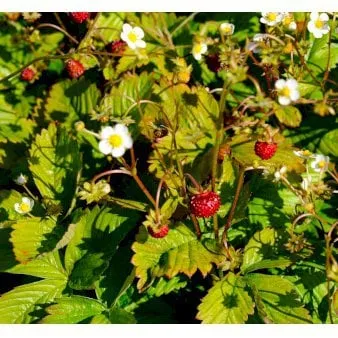
Wild strawberry (Fragaria vesca) is a perennial plant that grows low and forms dense clumps with runners that quickly spread and cover the ground. It thrives best in light to partial shade on moisture-retaining garden soil and requires only limited maintenance once established.
The plant grows to about 10–20 cm tall and has green, serrated leaves. In May–June, it blooms with small white flowers, which later develop into red, aromatic berries. Under favourable conditions, an additional flowering and fruiting may occur later in the summer.
Wild strawberry is suitable as ground cover in beds, under shrubs, or as a border plant in the kitchen garden. It is also a host plant for the butterfly Grizzled Skipper and thus contributes to biodiversity in the garden.
- Low-growing ground cover: Forms dense clumps and spreads with runners.
- Edible berries: Small, red, and aromatic fruits in the summer months.
- Flowering: White flowers in May–June, with the possibility of additional flowering later in the season.
- Placement: Thrives in sun to partial shade on moisture-retaining soil.
- Native species: Contributes to a natural and insect-friendly garden environment.
Pros and cons
- Easy to grow and undemanding plant
- Covers the ground effectively and suppresses weeds
- Produces edible berries
- Attracts pollinators and butterflies
- Can spread quickly and therefore requires some control in small beds
- The berries are small and ripen over an extended period
Pros and cons
Pros
- Easy to grow and undemanding plant
- Covers the ground effectively and suppresses weeds
- Produces edible berries
- Attracts pollinators and butterflies
Cons
- Can spread quickly and therefore requires some control in small beds
- The berries are small and ripen over an extended period
Pros
- Easy to grow and undemanding plant
- Covers the ground effectively and suppresses weeds
- Produces edible berries
- Attracts pollinators and butterflies
Cons
- Can spread quickly and therefore requires some control in small beds
- The berries are small and ripen over an extended period
Specifications
- Botanical name: Fragaria vesca
- Height: 10–20 cm
- Width: 20–40 cm
- Plant density: 7–9 plants per m²
- Plant spacing: approx. 30 cm
- Flowering period: May–June (possibly again later in the summer)
- Flower colour: White
- Fruit colour: Red
- Leaf colour: Green
- Growth form: Ground-covering, clump-forming with runners
- Placement: Sun / partial shade
- Growing conditions: Moisture-retaining garden soil
- Hardiness: Fully hardy
- Use: Ground cover, border plant, containers
- Ripening time: June–August
Product descriptions
Wild strawberry (Fragaria vesca) is a perennial plant that grows low and forms dense clumps with runners that quickly spread and cover the ground. It thrives best in light to partial shade on moisture-retaining garden soil and requires only limited maintenance once established.
The plant grows to about 10–20 cm tall and has green, serrated leaves. In May–June, it blooms with small white flowers, which later develop into red, aromatic berries. Under favourable conditions, an additional flowering and fruiting may occur later in the summer.
Wild strawberry is suitable as ground cover in beds, under shrubs, or as a border plant in the kitchen garden. It is also a host plant for the butterfly Grizzled Skipper and thus contributes to biodiversity in the garden.
- Low-growing ground cover: Forms dense clumps and spreads with runners.
- Edible berries: Small, red, and aromatic fruits in the summer months.
- Flowering: White flowers in May–June, with the possibility of additional flowering later in the season.
- Placement: Thrives in sun to partial shade on moisture-retaining soil.
- Native species: Contributes to a natural and insect-friendly garden environment.
Pros and cons
- Easy to grow and undemanding plant
- Covers the ground effectively and suppresses weeds
- Produces edible berries
- Attracts pollinators and butterflies
- Can spread quickly and therefore requires some control in small beds
- The berries are small and ripen over an extended period
Pros and cons
Pros
- Easy to grow and undemanding plant
- Covers the ground effectively and suppresses weeds
- Produces edible berries
- Attracts pollinators and butterflies
Cons
- Can spread quickly and therefore requires some control in small beds
- The berries are small and ripen over an extended period
Pros
- Easy to grow and undemanding plant
- Covers the ground effectively and suppresses weeds
- Produces edible berries
- Attracts pollinators and butterflies
Cons
- Can spread quickly and therefore requires some control in small beds
- The berries are small and ripen over an extended period
Specifications
- Botanical name: Fragaria vesca
- Height: 10–20 cm
- Width: 20–40 cm
- Plant density: 7–9 plants per m²
- Plant spacing: approx. 30 cm
- Flowering period: May–June (possibly again later in the summer)
- Flower colour: White
- Fruit colour: Red
- Leaf colour: Green
- Growth form: Ground-covering, clump-forming with runners
- Placement: Sun / partial shade
- Growing conditions: Moisture-retaining garden soil
- Hardiness: Fully hardy
- Use: Ground cover, border plant, containers
- Ripening time: June–August
Different types of fruit bushes
There are many types of fruit bushes, each with their own special characteristics, flavour and growing requirements. Here is an overview of some of the most popular ones.
1. Blackcurrants
Blackcurrants are robust and hardy bushes that thrive in most gardens. They produce dark, aromatic berries that are well suited for juice and jam. Blackcurrant bushes require minimal care and provide a stable yield year after year.
2. Redcurrants
Redcurrant bushes are known for their slightly tart berries, which are used for jelly, juice and desserts. They are easy to grow and thrive in both sun and partial shade. Redcurrants come in both red and white varieties.
3. Gooseberries
Gooseberries come in many colours – green, red and yellow – and have a fresh, tangy flavour. They are suitable for both fresh eating and baking. The bushes often have thorns, but there are also almost thornless varieties.
4. Raspberries
Raspberries are a classic in many gardens. They can be summer- or autumn-bearing, allowing for a long harvest season. Raspberries thrive best in light, moist soil and need support, as the shoots can grow tall.
5. Blueberries
Blueberries require acidic soil and thrive best in sphagnum-mixed soil or acid beds. They produce sweet, dark blue berries and are also decorative with their beautiful autumn colours. Plant several varieties for better pollination.
6. Blackberries
Blackberry bushes produce large, juicy berries and can be used for both fresh eating and preserves. Most varieties are climbing and require tying up, but there are also more compact varieties for smaller gardens.
Different brands of fruit bushes
Several producers and nurseries offer high-quality fruit bushes, often differing in range, breeding and areas of focus.
Jespers Planteskole
Jespers Planteskole is known for a wide selection of fruit bushes, including many Danish varieties adapted to the Nordic climate. The focus is on healthy plants with high fruit set and easy care.
Plantetorvet
Plantetorvet offers a large range of fruit bushes online, with detailed descriptions and guidance for choosing varieties. The range spans from classic berry bushes to rarer varieties such as tayberries and aronia.
Lundhede Planteskole
Lundhede specialises in quality plants for both private and professional customers. Their fruit bushes are available in many sizes, and they emphasise robustness and a high survival rate after planting.
Bilka Garden Centre
Bilka offers a wide selection of fruit bushes at affordable prices. The range is aimed at hobby gardeners and makes it easy to get started with fruit production in the garden.
Plantorama
Plantorama combines a garden centre and experience universe and offers a varied selection of fruit bushes. They focus on easy solutions and inspiring displays that make it easier to choose the right plants.
Frequently asked questions
When is the best time to plant fruit bushes?
The best time to plant fruit bushes is in autumn or early spring, when the soil is moist and the plants can establish themselves before the growing season begins.
How much water do fruit bushes need?
Newly planted bushes should be watered regularly, especially during dry periods. Once established, most manage with natural rainfall, but extra watering during drought increases yield.
Should fruit bushes be fertilised?
Yes, an annual addition of compost or organic fertiliser in spring provides better growth and more berries. Avoid too much nitrogen, as it can cause strong leaf growth at the expense of fruiting.
How long does a fruit bush live?
Most fruit bushes can live for 10–20 years, depending on variety and care. Regular pruning and good soil maintenance extend their lifespan and ensure a stable yield.
Can fruit bushes be grown in pots?
Yes, many smaller varieties – especially blueberries and redcurrants – thrive well in large pots if they get enough water and nutrients. Ensure good drainage and use quality soil suited to the plant type.
Læs også: